
A Program Of Renaissance Philanthropy, The Competition Will Award $3 Million Across Three Tracks
NEW YORK, June 23, 2026 – The Tools Competition – the world’s largest ed tech competition and a flagship program of Renaissance Philanthropy – announced today more than $3 million in funding to 21 teams of developers poised to improve learning and career outcomes with research-based, technical solutions.
Through the competition, Renaissance Philanthropy identifies and accelerates ambitious innovators using technology to solve vexing problems in education. As part of Renaissance Philanthropy’s broader education portfolio, the program helps surface breakthrough ideas early, support promising teams in building evidence, and move technical innovation toward real-world impact.
This year’s Tools Competition winners showcase how the rapid evolution of AI is drastically accelerating the pace of development, enabling more ambitious solutions than ever before. Their efforts span tools that deepen how students learn, strengthen how teachers teach, and expand access to postsecondary and career pathways. Rather than creating isolated applications, they are building ambitious, public-good infrastructure designed to advance research and set a positive direction for the entire field. Together, these newly-funded technologies could reach over 5 million learners and educators around the globe over the coming year.
An annual multi-million dollar funding opportunity, the Tools Competition, organized by The Learning Agency, is supported by a unique coalition of global donors, including: the Walton Family Foundation, Griffin Catalyst, Axim Collaborative, Oak Foundation, Cinelli Family Foundation, Gordon and Betty Moore Foundation, and the Chan Zuckerberg Initiative.
Notable proposals receiving prizes today include:
- FUNKE SENSE LAB: An interactive science tool that combines hands-on experiment kits with 3D visuals and voice guidance to make learning STEM easy, accessible, and fun for neurodiverse learners.
- PAL for Early Math Learning: An AI-powered system built on research about how children learn math, allowing it to give teachers personalized, easy-to-follow guidance for activities tailored to exactly what their students are ready to learn next.
- Navvy: An easy-to-use online tool that helps college students determine if they qualify for assistance programs like food stamps and health insurance, and then guides them through the application process so they can focus on school.
- Multimodal College-Level Writing and Feedback Dataset: A college-level writing dataset contains student essays, teacher grades and feedback, and recorded office hour discussions, all collected to study how students learn to write and to test how well AI can provide helpful feedback.
A complete list of winners can be found here.
“The scale of what this year’s winners will achieve is energizing,” said Kumar Garg, President, Renaissance Philanthropy. “Over six cycles, this competition is proving that thoughtful, targeted philanthropy can steer the rapid development of AI by focusing on the precise tools and benchmarks that ensure new technology is helping to solve society’s most pressing educational challenges.”
The 2026 competition included prizes in three tracks:
- Accelerating K-12 Learning Track
- Building Pathways to Postsecondary Success Track
- Datasets for Education Innovation Track
The 2026 competition cycle also introduced two new priorities: accessibility-first tools and AI-enabled tools that support science curiosity. These priorities reflected a growing need for inclusive technologies that reduce barriers for students with learning differences and disabilities, as well as tools that use AI to help young people explore authentic questions, investigate real-world problems, and reason with evidence. The competition emphasized the importance of designing tools that broaden participation, strengthen inquiry-driven learning, and support students across the many contexts where learning takes place.
Also today, the Tools Competition released Building Better AI for Learning, a new report drawing on six years of competition learnings to examine where ed tech is headed. The report explores how developers are using AI, what problems they are working to solve, and which approaches are gaining traction, featuring concrete examples from this year’s winners to show how these trends are emerging in practice.
Among the report’s findings:
- Building a basic tool on top of ChatGPT is no longer enough to stand out or be truly useful. Instead, the strongest creators are focusing on the specialized software they build around the AI.
- Ambitious work is focused on building custom voice-recognition and language systems designed for learners whose voices, speech patterns, or language backgrounds are often not represented in existing models.
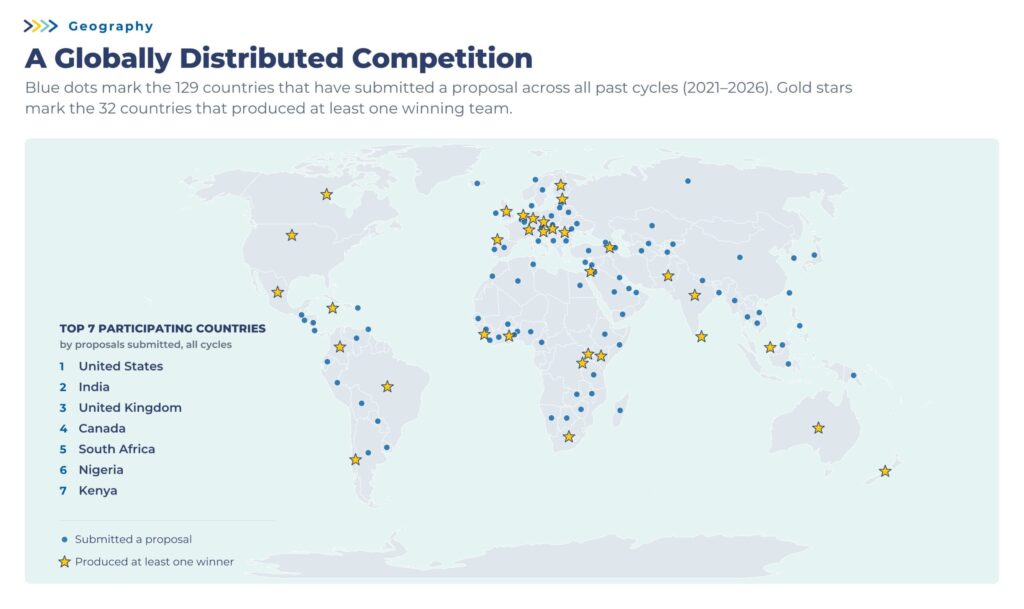
This is the sixth cycle of the Tools Competition. To date, the competition has awarded more than $24 million to 171 ed tech innovators that are reaching over 51 million learners and educators worldwide.
The next cycle will launch in September 2026. To learn more, join the mailing list here.
Background
The Tools Competition is the largest ed tech competition in the world. It spurs innovation in digital technology, big data, and learning science to meet the urgent needs of learners worldwide.
The Tools Competition is a program of Renaissance Philanthropy, organized by The Learning Agency, and made possible through the generous support of the Walton Family Foundation, Griffin Catalyst, Axim Collaborative, Oak Foundation, Cinelli Family Foundation, Gordon and Betty Moore Foundation, and Chan Zuckerberg Initiative.
The competition is run in partnership with the University of Minnesota Department of Educational Psychology and Digital Harbor Foundation.