


KIVA, the Knowledge Integration and Vocabulary Accelerator, is an open-source, web-based AI reading companion that helps children build vocabulary while reading or listening to books and other texts. Designed for students who are at risk for or experiencing reading difficulties, KIVA pairs grade-level content with interactive read-alouds, explicit vocabulary instruction, and adaptive scaffolding through a conversational avatar. The platform uses child-optimized speech recognition and an empirically evaluated tutoring system to personalize instruction and generate learning and engagement data for educators.


Ola Ozernov-Palchik
Researcher, Boston University/MIT
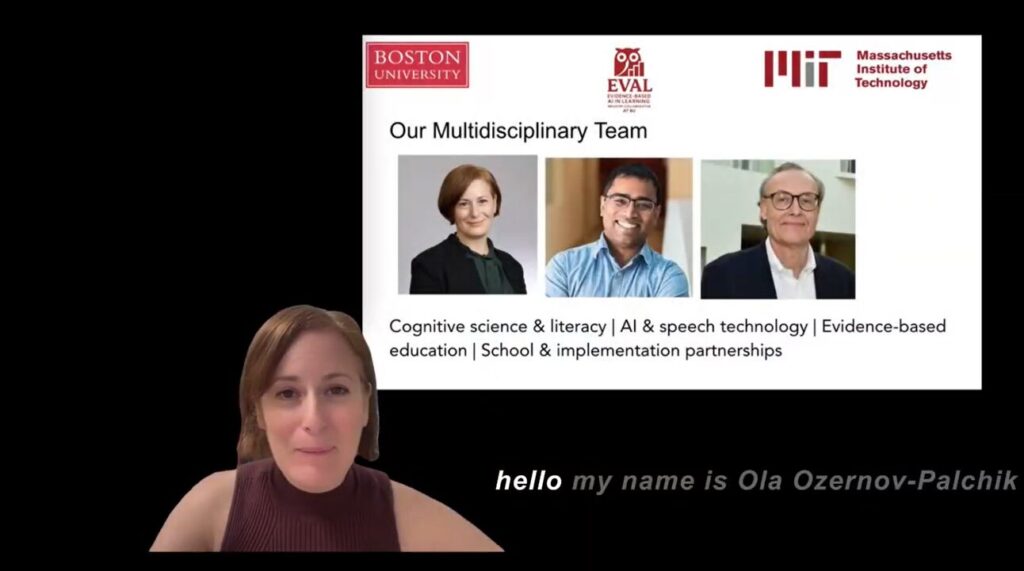
Ola Ozernov-Palchik, PhD, is a cognitive neuroscientist whose research focuses on how children learn to read and why some children struggle. Her work examines the cognitive, linguistic, and neural foundations of literacy development and developmental dyslexia, with an emphasis on improving early identification and intervention. She also studies how AI-enabled technologies can be grounded in rigorous evidence to support more precise, equitable, and effective learning. She is the founder and director of EVAL, Evidence-Based AI in Learning, a Boston University research infrastructure that generates decision-useful evidence on AI-enabled K–12 educational tools. Her work has been published in venues including Nature Communications, NeuroImage, Scientific Studies of Reading, and NeurIPS, and has been supported by federal agencies and private foundations. Previously, she directed the Mind, Brain, and Education master’s program at the Harvard Graduate School of Education.